
Global Fiberglass Market to Reach USD 21 Billion by 2036 as Construction, Renewable Energy, and Lightweighting Trends Drive Demand
Driven by infrastructure development, wind energy expansion, and automotive lightweighting, fiberglass consumption accelerates across industrial and advanced material sectors.
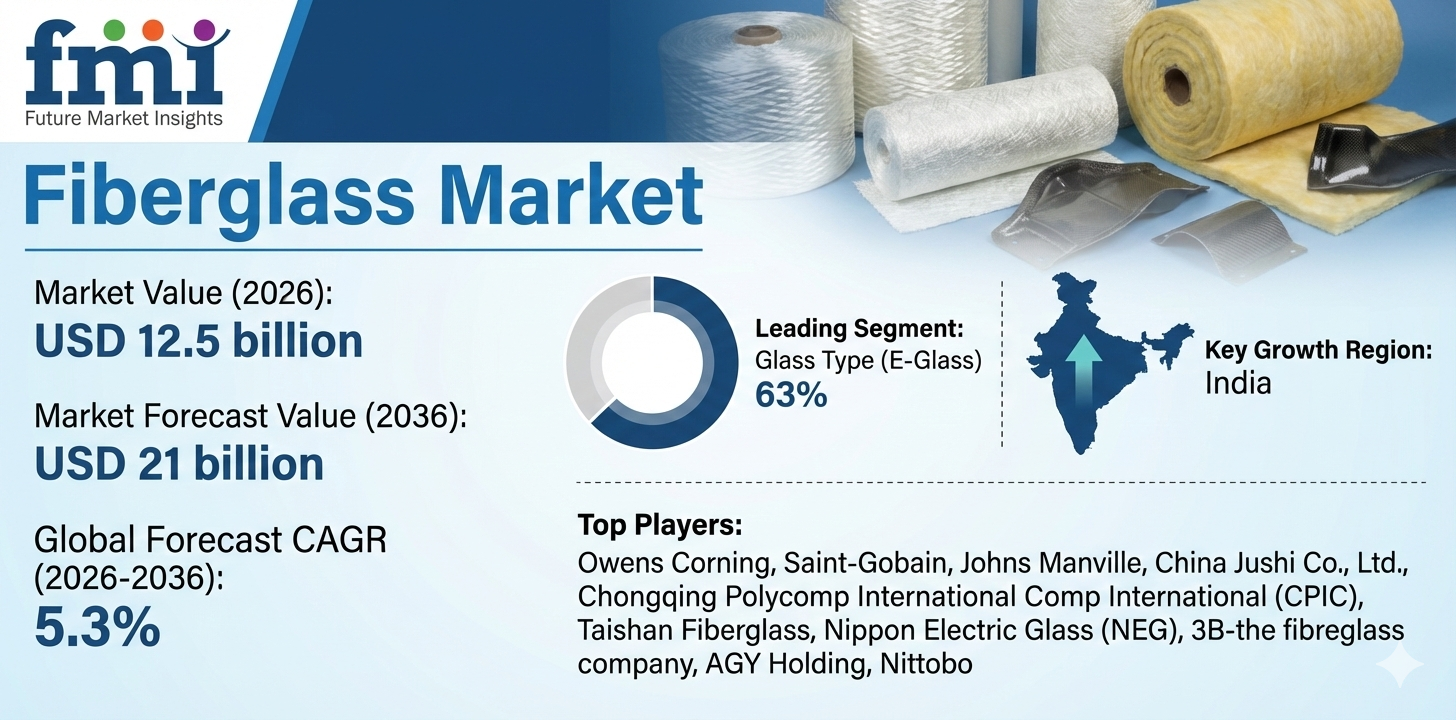
NEWARK, DELAWARE / ACCESS Newswire / February 11, 2026 / The global fiberglass market is entering a phase of steady expansion, projected to grow from USD 12.5 billion in 2026 to USD 21 billion by 2036, reflecting a compound annual growth rate (CAGR) of 5.3%. According to industry outlooks, sustained demand from construction, automotive, wind energy, and infrastructure applications is reinforcing fiberglass's role as a critical reinforcement material for modern composite systems.
Fiberglass continues to gain traction due to its high strength-to-weight ratio, corrosion resistance, and durability, making it a preferred solution in sectors focused on performance optimization and energy efficiency. India is emerging as one of the fastest-growing markets, while China and the United States remain major consumption hubs supported by large-scale manufacturing ecosystems and infrastructure investments.
As industries increasingly prioritize lightweight materials and sustainable construction practices, fiberglass remains central to innovation across building materials, transportation, and renewable energy systems.
Rovings and Construction Applications Form the Market Backbone
Fiberglass rovings dominate the global market, accounting for approximately 46% of total demand. These continuous glass fiber strands are widely used as reinforcement in composite materials across construction, automotive, wind energy, and marine applications. Rovings offer excellent tensile strength, flexibility, and processing efficiency, enabling manufacturers to produce durable, lightweight components through techniques such as pultrusion, filament winding, and hand lay-up.
Construction represents the largest end-use segment, contributing nearly 29% of global fiberglass demand. Fiberglass is extensively utilized in reinforcement, insulation, roofing, and fiberglass-reinforced plastics (FRP), where its resistance to corrosion, moisture, and chemicals delivers long service life and reduced maintenance requirements. Growing urbanization and infrastructure development worldwide continue to support stable consumption from the construction sector.
Other key applications include automotive, wind energy, pipes and tanks, marine, aerospace and defense, and sports and leisure equipment, underscoring fiberglass's versatility across diverse performance-driven industries.
"Fiberglass remains indispensable where durability, lightweighting, and structural reliability are essential," notes industry analysis. "From energy-efficient buildings to wind turbine blades, fiberglass composites enable performance gains and long-term cost efficiency across high-growth sectors."
Infrastructure Development and Renewable Energy Drive Consistent Adoption
Global demand for fiberglass is strengthening as industries respond to infrastructure expansion, sustainability goals, and transportation efficiency requirements:
Construction Growth: Increasing use of fiberglass in reinforcement and insulation supports energy-efficient building practices.
Automotive Lightweighting: Fiberglass composites help reduce vehicle weight, improving fuel economy and electric vehicle range.
Wind Energy Expansion: Large fiberglass-reinforced blades remain critical for onshore and offshore wind turbine installations.
Infrastructure Investment: Pipes, bridges, and roofing systems benefit from fiberglass's corrosion resistance and durability.
Industrial Applications: Marine, electronics, and machinery sectors continue to adopt fiberglass for performance reliability.
However, raw material price volatility, energy-intensive manufacturing processes, and competition from alternative composites such as carbon fiber present ongoing challenges. In response, manufacturers are investing in production efficiency, recycling technologies, and low-emission processes to improve sustainability and cost competitiveness.
Regional Growth Engines: India Accelerates, China and the United States Anchor Demand
The fiberglass market is expanding globally, led by Asia Pacific and supported by steady demand in North America and Europe.
Country | Projected CAGR (2026-2036) | Primary Growth Drivers |
India | 7.8% | Infrastructure development, automotive manufacturing, wind energy |
China | 5.9% | Construction, automotive lightweighting, renewable energy |
United States | 2.9% | Automotive composites, wind energy, construction materials |
France | 2.4% | Energy-efficient buildings, renewable energy |
Japan | 2.2% | Automotive components, insulation, wind energy |
India emerges as the fastest-growing national market, fueled by rapid urbanization, expanding infrastructure projects, and increased adoption of fiberglass in automotive and renewable energy applications. China maintains strong demand through its role as a global manufacturing hub, while the United States continues to anchor consumption across automotive, construction, aerospace, and wind energy sectors.
European markets such as France benefit from sustainability-driven building regulations, while Japan sustains steady growth through lightweight transportation components and energy-efficient construction.
Sustainability and Advanced Composites Shape Market Evolution
Despite favorable demand trends, the fiberglass industry faces increasing environmental scrutiny related to energy consumption, emissions, and composite waste. Manufacturers are responding through innovation and sustainability initiatives, including:
Development of recyclable and bio-based resin systems paired with glass fibers
Investment in low-emission melting and fiber-forming technologies
Exploration of closed-loop recycling for composite materials
Integration of automation and digital manufacturing to improve quality and reduce waste
Hybrid composite systems combining fiberglass with other fibers for tailored performance
Long-term scalability depends on balancing production efficiency with environmental compliance while meeting evolving performance requirements across construction, transportation, and renewable energy markets.
Competitive Landscape and Market Dynamics
The global fiberglass market remains moderately consolidated, with leading players benefiting from economies of scale, vertically integrated operations, and established global distribution networks. Competition increasingly centers on product innovation, sustainability credentials, and application-specific solutions rather than volume alone.
Major producers continue to expand capacity to support growing demand from wind energy and construction while advancing lightweight composite technologies for automotive and industrial applications. Companies that successfully integrate eco-friendly production practices and advanced material engineering are expected to maintain a competitive edge.
Key Players in the Fiberglass Market
Owens Corning
Saint-Gobain
Johns Manville
China Jushi Co., Ltd.
Chongqing Polycomp International (CPIC)
Taishan Fiberglass
Nippon Electric Glass (NEG)
3B-the fibreglass company
AGY Holding
Nittobo
These companies compete through innovation, sustainability initiatives, and expansion into high-growth regions, reinforcing fiberglass's strategic importance within the broader material sciences industry.
For an in-depth analysis of evolving formulation trends and to access the complete strategic outlook for the Fiberglass Market through 2036, visit the official report page at: https://www.futuremarketinsights.com/reports/fiberglass-market
Related Reports:
Fiberglass Fabric Market: https://www.futuremarketinsights.com/reports/fiberglass-fabric-market
Fiberglass Cloth Market: https://www.futuremarketinsights.com/reports/fiberglass-cloth-market
Coated Fabrics Market: https://www.futuremarketinsights.com/reports/coated-fabrics-market
Acoustic Fabrics Market: https://www.futuremarketinsights.com/reports/acoustic-fabrics-market
About Future Market Insights (FMI)
Future Market Insights (FMI) is a leading provider of market intelligence and consulting services, serving clients in over 150 countries. Headquartered in Delaware, USA, with a global delivery center in India and offices in the UK and UAE, FMI delivers actionable insights to businesses across industries including automotive, technology, consumer products, manufacturing, energy, and chemicals.
An ESOMAR-certified research organization, FMI provides custom and syndicated market reports and consulting services, supporting both Fortune 1,000 companies and SMEs. Its team of 300+ experienced analysts ensures credible, data-driven insights to help clients navigate global markets and identify growth opportunities.
For Press & Corporate Inquiries
Rahul Singh
AVP - Marketing and Growth Strategy
Future Market Insights, Inc.
+91 8600020075
For Sales - [email protected]
For Media - [email protected]
For web - https://www.futuremarketinsights.com/
SOURCE: Future Market Insights, Inc.
Information contained on this page is provided by an independent third-party content provider. XPRMedia and this Site make no warranties or representations in connection therewith. If you are affiliated with this page and would like it removed please contact [email protected]
