
3D Printed Surgical Models Market to Expand Rapidly with Growth in Personalized and Pre-Surgical Planning
The global 3D printed surgical models market is entering a phase of accelerated clinical adoption
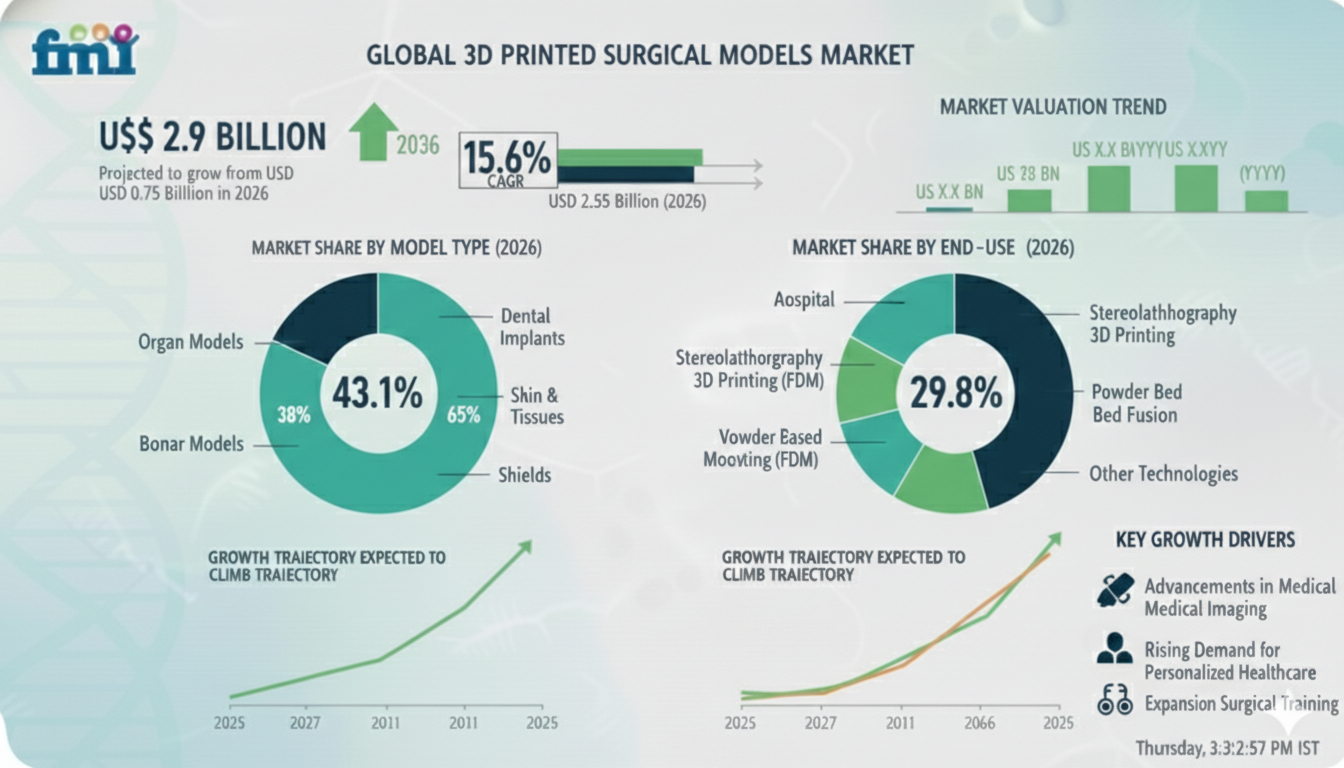
NEWARK, DELAWARE / ACCESS Newswire / February 11, 2026 / The global 3D printed surgical models market is entering a phase of accelerated clinical adoption, driven by rapid advances in point-of-care manufacturing, personalized medicine, and high-fidelity visualization technologies. Valued at USD 0.75 billion in 2026, the market is projected to expand to USD 2.9 billion by 2036, registering a robust CAGR of 15.6%.
This strong growth reflects a structural transformation in how hospitals, surgeons, and healthcare systems approach complex procedures. Once viewed primarily as educational or prototyping tools, 3D printed surgical models are now becoming mission-critical clinical assets that directly enhance surgical precision, patient safety, and operating room efficiency.
According to a comprehensive strategic outlook from Future Market Insights (FMI), the market's expansion is being fueled by rising demand for patient-specific surgical planning tools, increasing investments in hospital-based 3D printing labs, and growing validation from clinical studies demonstrating improved outcomes.
A pivotal clinical study published by the National Institutes of Health (NIH) in July 2025 validated that patient-specific guides reduced pedicle screw perforation rates to just 0.5%, significantly enhancing surgical safety profiles. This evidence is accelerating adoption across orthopedic, neurosurgical, cardiovascular, and pediatric specialties.
"We're able to materialize what surgeons only see on screens. Holding the model in their hands, they can rotate and see if there are any difficulties they will encounter during surgery," said Dr. Devid Zille, Director of the USF-Tampa General 3D Medical Visualization & Printing Lab.
The Clinical Shift: From Visualization to Surgical Infrastructure
The industry is undergoing a fundamental shift as 3D printed models move from outsourced services to in-house hospital production environments. Clinicians and administrators are increasingly prioritizing internal 3D printing labs to reduce turnaround times for complex cases and maintain tighter control over quality and regulatory compliance.
Innovations in stereolithography (SLA) now enable rapid production of transparent, color-coded organ replicas that significantly improve pre-operative visualization. These advancements allow surgeons to better understand intricate anatomies, rehearse procedures, and anticipate complications before entering the operating room.
Data released by Rady Children's Hospital in November 2025 revealed that cross-disciplinary hospital labs produced dozens of models within months of expansion, dramatically increasing access for complex pediatric cases. FMI projects that this point-of-care manufacturing trend will remain a defining growth driver through 2036.
Organ Models Lead as High-Value Clinical Assets
Organ models remain the dominant product segment, accounting for 43.1% of global market share. Their leadership is driven by their unmatched ability to translate 2D CT and MRI imaging into tactile, patient-specific physical representations.
Unlike virtual simulations, physical organ models allow surgical teams to practice tactile maneuvers and spatial orientation-making them indispensable for complex congenital defects, neurological procedures, and cardiovascular interventions. Adoption of advanced 3D reconstruction technology continues to reinforce this dominance, particularly in neurosurgery, where 3D printed brain models are heavily relied upon for surgical planning.
Market Metrics at a Glance (2026-2036)
Market Metric | Value / Detail |
|---|---|
Current Market Value (2026) | USD 0.75 Billion |
Projected Market Value (2036) | USD 2.9 Billion |
Global Growth Rate (CAGR) | 15.6% |
Leading Product Segment | Organ Models (43.1%) |
Leading Technology | Stereolithography (29.8%) |
Top Growth Market | India (22.6% CAGR) |
Stereolithography Emerges as the Leading Technology
On the technology front, Stereolithography (SLA) is projected to maintain its leadership position with a 29.8% market share. SLA's ability to deliver ultra-high resolution, transparent, and biocompatible parts makes it the preferred choice for visualizing internal vascular structures and producing sterilizable surgical tools.
Recent innovations continue to shorten production timelines. In May 2024, Formlabs introduced the Form 4, capable of printing detailed surgical models in under two hours-addressing critical time constraints in acute and emergency care environments.
Regional Growth Accelerates Across Asia, Europe, and North America
While North America and Europe remain high-value markets, the fastest growth is occurring across Asia:
India (22.6% CAGR): India is emerging as the fastest-growing national market, driven by rapid adoption of advanced medical technologies and a massive patient base. Government incentives for domestic manufacturing and healthcare modernization are accelerating installation of hospital-based 3D printing labs.
China (21.3% CAGR): China is leveraging its large-scale manufacturing ecosystem and strong regulatory momentum. In July 2024 alone, China's National Medical Products Administration approved 265 new medical devices, signaling a supportive environment for additive manufacturing in healthcare.
France (16.9% CAGR): France's growth is driven by strict EU MDR compliance requirements, favoring companies that offer fully validated, end-to-end clinical workflows. Government investment under the "France 2030" plan is further strengthening healthcare manufacturing infrastructure.
United States (11.5% CAGR):S. hospitals are integrating 3D printing labs directly into radiology and surgical departments, establishing clinical best practices for physical surgical planning models.
Japan (13.8% CAGR): Japan is focusing on high-precision, digital on-demand production to support specialized clinical needs, leveraging its engineering excellence.
Dynamics of the Decade: AI, Materials, and Medical-Grade Ecosystems
Looking toward 2036, several transformative trends are expected to reshape the competitive landscape:
Point-of-Care Manufacturing: Hospitals are building in-house labs to enable rapid, on-demand production of FDA-cleared models.
AI-Driven Segmentation: AI algorithms are accelerating scan-to-model conversion. In December 2025, Axial3D received FDA clearance for AI tools that significantly reduce design time.
Material Innovation: Advances in biocompatible and sterilizable resins are enabling broader use of 3D printed tools directly in operating rooms.
Solution-as-a-Service Models: Vendors are shifting toward integrated software-hardware-material ecosystems, offering hospitals full-stack clinical solutions rather than standalone printers.
Competitive Landscape
The market is experiencing strategic consolidation as leading players focus on building medical-grade, workflow-integrated ecosystems. Major companies are expanding beyond hardware into certified materials, AI-powered software, and hospital integration services.
Key Players in the 3D Printed Surgical Models Market include:
3D Systems, Materialise, Stratasys, Formlabs, Axial3D, Anatomiz3D, EnvisionTEC (Desktop Metal), SYNBONE AG, Xilloc, and Simulab Corporation.
These companies are increasingly pursuing acquisitions and partnerships to strengthen their clinical software capabilities and secure long-term hospital relationships.
For an in-depth analysis of evolving technologies, clinical applications, and regional growth opportunities in the 3D Printed Surgical Models Market through 2036, visit the official report page at: https://www.futuremarketinsights.com/reports/3d-printed-surgical-models-market
Related Reports:
Demand for 3D Printed Surgical Models in Japan: https://www.futuremarketinsights.com/reports/japan-printed-surgical-models-market
3D Printed Medical Devices Market:https://www.futuremarketinsights.com/reports/3d-printed-medical-devices-market
3D Printed Drugs Market:https://www.futuremarketinsights.com/reports/3d-printed-drugs-market
3D Printed Dental Brace Market:https://www.futuremarketinsights.com/reports/3d-printed-dental-brace-market
3D-Printed Prosthetic Implants Market: https://www.futuremarketinsights.com/reports/3d-printed-prosthetic-implants-market
About Future Market Insights (FMI)
Future Market Insights (FMI) is a leading provider of market intelligence and consulting services, serving clients in over 150 countries. Headquartered in Delaware, USA, with a global delivery center in India and offices in the UK and UAE, FMI delivers actionable insights to businesses across industries including automotive, technology, consumer products, manufacturing, energy, and chemicals.
An ESOMAR-certified research organization, FMI provides custom and syndicated market reports and consulting services, supporting both Fortune 1,000 companies and SMEs. Its team of 300+ experienced analysts ensures credible, data-driven insights to help clients navigate global markets and identify growth opportunities.
For Press & Corporate Inquiries
Rahul Singh
AVP - Marketing and Growth Strategy
Future Market Insights, Inc.
+91 8600020075
For Sales - [email protected]
For Media - [email protected]
For web - https://www.futuremarketinsights.com/
SOURCE: Future Market Insights, Inc.
Information contained on this page is provided by an independent third-party content provider. XPRMedia and this Site make no warranties or representations in connection therewith. If you are affiliated with this page and would like it removed please contact [email protected]
